Regardless of your politics, ideology, religious beliefs, or affiliation there is a element of this election that reaches beyond simple history. This event is one of those foundational movements in history when things shift. Events like the crossing of the Delaware, the return of Lewis and Clark, Hiroshima, and the Arkansas Nine.
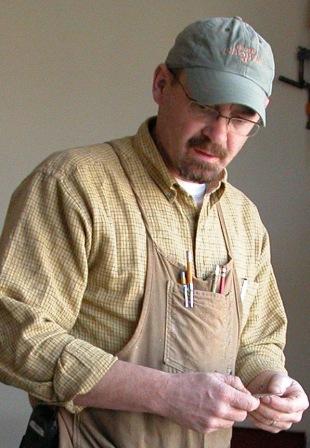
America has always represented an ideal; an egalitarian society; a place of almost limitless possibility. Perhaps the first in the history of civilization and certainly a place that, at least on its face, represents the future of humankind. However, that ideal has been tainted by racism; by the specter that some are not equal. For our lifetimes that fact has been just underneath our collective skin; our promise unfulfilled; our destiny derailed. Photo: Revolution Studios
There is something new. Nothing ends, yet no one had such a bold dream that the pendulum of history could change with one event.  That is why the old men weep. The victory in this election is not Obama's alone, but it is the exhaling of a million held breaths. Perhaps the victory is not Obama's at all. It is our victory. The realization that history will mark this single point as an end to what Truman began is, for many, beyond words. That the silent protest of Rosa Parks, the cries of King, and the sacking of Detroit are not only behind us, but that we did in fact produce a more perfect Union. That we can go froward. That the dreams of all can now be our collective dream.
If possible, there is even something bigger. Beyond these shores, there are children in Kenya and university students in France who look to us, and with joy and hope, wonder if what we have accomplished - they can accomplish. We can only hope.
Thursday, January 22, 2009
The New President - An Historical Perspective

Thursday, August 16, 2007
The Flower or the Bee
There are some things thrust upon us, some we bring on ourselves, and some things tip us spinning and careening into chaos. We view them as bad, we view them as good; and yet, we do not know the end. Perhaps we should not be so quick to judge. A farmer named Sei Weng owned a beautiful mare which was praised far and wide. One day this beautiful horse disappeared. The people of his village offered sympathy to Sei Weng for his great misfortune. Sei Weng said simply, "Who can say what is good or bad?"
 A few days later the lost mare returned, followed by a beautiful wild stallion. The village congratulated Sei Weng for his good fortune. He said, "Who can say what is good or bad?"
Some time later, Sei Weng's only son, while breaking in the stallion, fell off and broke his leg. The village people once again expressed their sympathy at Sei Weng's misfortune. Sei Weng again said, "Who can say what is good or bad?"
Soon thereafter, war broke out and all the young men of the village except Sei Weng's lame son were drafted and were killed in battle. The village people were amazed as Sei Weng's good luck. His son was the only young man left alive in the village. But Sei Weng kept his same attitude: despite all the turmoil, gains and losses, he gave the same reply, "Who can say what is good or bad?"
Monday, July 30, 2007
Dichotomy
I ran across this quote recently while rambling around blogesphere.
“I am trying to check my habits of seeing, to counter them for the sake of greater freshness. I am trying to be unfamiliar with what I am doing.” Robert Rauschenberg
I thought the statement fantastic on many levels. Those of you that know me, or read this blog know that I am interested in dichotomy. I see a lot of dichotomy in this statement.
 I didn't known of him, but Rauschenberg is an American artist noted for his collages, photomontages, and paintings that incorporate photographs and real objects. I found out, therefore, he was obviously speaking about the creative process. Some of you know exactly what the creative process is, but I think an explanation is in order. Or, perhaps an attempt. The culmination of a successful creative process the creation of an object (i.e. photograph, sculpture, etc...), or an event (i.e. play, movie, comedy, etc..) which people recognize as excellent. I'm not going to discuss what is art, or what is good art, but let us assume we know excellence when we see it. i.e. - I'm not talking about the stuff on the margins.
One of the obvious questions concerning excellence is, how is it attained? How is it manifest? How do people create this stuff? What might we understand about their process which we could bring to ours?
I would argue that most of what we recognize as excellent was intuitively created. People work years for this gift - artists in particular.
 I believe Danial Libekind's recent addition to Denver's skyline; the Denver Art Musuem, was originally quite literally sketched on scrap paper. That which is intuitive is prized. Malcolm Gladwell is enjoying the profits from a recent best seller called Blink (see my post, recent & recommended). It is about trusting and being guided by our intuitive selves. Zen is all about being so good at something we forget how we do it. It is best illustrated by driving. When we first start driving it takes concentration to keep the car between the lines. As years pass we forget it was ever a difficultly - it is natural, without thought, and completely without effort. There is still effort, but we are so good the effort is unnoticed. That's the zen of driving. That is the intuitive process illustrated. So is riding a bike, typing, clicking save, writing a good brief, changing a diaper - we forget what we're doing. We all know....the zone.
Rauschenberg is asking us to forget the zone - to look again, to be unfamiliar with that with which we are familiar. Blasphemy! But wait, what if we could look at that brief again, that response to a request for quote, the way we turn a bolt, run a saw, or even; dare I say, look at a spouse. Depending on the thing - Could we find freshness? Could we find imperfection? Could we find less (or more) in what we see so often.
In one of my poems, given below, I originally wrote the last line of the first stanza to read, "Of seeing, but not seeing natures cruel fight". I was after this same idea, this idea of seeing fresh. I later changed the line; it sounds better, but maybe....
There is something in me that loves the white
Of new soft snow, all quiet, No wing a flight.
I need this steady diet
Of stark straight trees against the gray light,
Of feeling, but not seeing natures cruel fight.
The cold it wanders lost throughout my bones.
Its feel, its life, its death doth hone
This single thought - That I am here alone,
And this, this is what I've sought.
© Artis Brazee
Saturday, March 10, 2007
Passion, Age & Identity
— Friedrich Nietzsche

Passion is the mirror of identity and identity the mirror of passion.
Many people define themselves by what they do or how they relate to others - a mom, an attorney, a racer, a biker, a web designer, an executive, a husband, or an artist. And I would guess, that even those that might deny it most likely do so. This "self-identity" often contains more than one definition. Someone might see themselves as a racer and a dad, or an attorney and a biker or even an artist, a mom, and a biker. Actually, having many passions is healthy. (Too many might be a problem - gee never been there....) Intellectual pursuits, the pursuits of family, and physical pursuits, all in sync, are the mark of a balanced life and most likely a balanced person. Often these self-identities happen to also be our passions. Joesph Campbell in "The Power of Myth" called this following your bliss.
People are fulfilled and happiest when their passion is also what they do - be it a job or some athletic pursuit, hobby, or other things they spend their time on. Certainly, the pursuit of our passions fills us with deep satisfaction.
Sometimes age overcomes our passions - we change. Lost passion isn't necessarily a bad thing - sometimes we just move on. The difficultly comes in the letting go and not loosing our identities. I once defined myself as a climber - it was truly a passion. I still love it, but now it doesn't dominate my life. I've simply have other passions now, but I still am that climber and all that I learned is still with me. (see Recreating Ones' Self) Some people get lost when passion fades, and it does so naturally, just as it should. When this happens they suddenly don't know what they are, where they're going, and what to do. There is most likely some of this in a mid-life crisis. I would go so far as to say each new decade brings new passions - I guess the trick is learning to move on to new things while still keeping our personal perspective in place. That sense of who we are and where we're going is very central to everyday life.
It is also important that our passions define us in a healthy way. For example, some might define themselves by their beauty and as they grow old the vain attempt not to loose that identity presents the world with a sad picture indeed. I think it goes without saying that our passions need to be healthy. I'm really not discussing unhealthy pursuits - that's another topic altogether.
"One person with passion is better than forty people merely interested."
— E. M. Forster
"With out passion you don't have energy, with out energy you have nothing."
— Donald Trump
Painting by Tammi Brazee, Seeing Red 2006 (kind-of reminded me of many passions)
Tuesday, February 20, 2007
Wikinomics
In the traditional business model a company dreams up a product, builds the prototype, develops the product through testing, accomplishes quality control and then brings the product to market. That paradigm is ending, or at least changing. This isn't just some new business theory - it a fundamental change in the way things are getting done. In the last few years, traditional collaboration—in a meeting room, a conference call, even a convention center—has been superseded by collaborations on an astronomical scale. Wikinomics is mainly about innovation and how web-based collaboration is driving it. Also, the book speaks to organizational dynamics and how the web is eating away at traditional hierarchies.
In the book, Wikinomics the , the authors document a new trend, a new way of getting things done that is changing traditional model in major ways. The word "wiki" means "quick" in Hawaiian, and here author and think tank CEO Tapscott (The Naked Corporation), along with research director Williams, paint in vibrant colors the quickly changing world of Internet togetherness, also known as mass or global collaboration, and what those changes mean for business and technology.
In Google News I ran across a story about a new product Adobe is putting out called Photshop Lightroom 1.0. The software was freely available as a beta version for just over a year during which Adobe used its market; the professional photographer, to develop the final version. They called it a massive collaborative effort. While launching the new digital photography software, John Loiacono, senior vice president, Creative Solutions Business Unit at Adobe, has said, “It’s an unlikely scenario that professional photographers would moonlight as software developers,” adding further that “Fortunately for us, they were willing to give it a shot. Everything, from image viewing and evaluation tools to time saving editing features, was developed with the help of photographers. This was truly a collaborative effort and we extend our thanks to everyone who provided invaluable feedback to help us deliver a powerhouse professional photography tool.”
Wow, how's that for a new way to do business - allow the users to develop the product. The company saves most of the R&D cost, creates a better product, perhaps a cheaper product, and it's exactly what the end user wants. The beta version expires at the end of this month and the new version is available now.
This is an interesting trend and I recommend the book. Now only do you begin to see a new business model, but a new societal shift. (Witness Adobe in the news just today) For those who loved The World is Flat, but got lost in the global scope, Wikinomics focuses on our real-time world. Wikinomics focuses on the impact of recent technologies, and on the way business must conduct themselves for the future, if they want to thrive.
If you study this graphic a bit you can begin to see the power of global mind - wasn't there an old Star Trak about a race who existed in one body - a giant mind? I digress - here it is...
Friday, October 06, 2006
Mind Maps
If you goggle "mind map" you get about 134 million results, yet I don't think many people know what mind mapping is. A guy named Dr. Allen Collins invented the concept in the 60's to help his students, but I noticed in the book, "How to Think like Leonardo" that Leonardo used this method and may have actually invented it. I became aware of it several years ago and now I use it quite a bit. It is especially useful in making complex decisions, and especially useful for decisions encountered in business - litigation, planning, strategy, etc.... I would best describe it as stream of conciseness thinking, but without forgetting all of the variables you may have identified while thinking - now they are laid out in front of you. You can move them, delete them, add to them, etc... Every idea is attached to every other idea with numerous links which reduces the complex to one dimension and thus a better decision. It is a semantic representation of the thought process. The best way to describe it is to actually do it and it is quite easy.
Freeware is a topic I should write about sometime, but anyway - there is an excellent program which is free (hence freeware or open source) and works intuitively called Freemind. It is easy to find a download location. I highly recommend it - you'll look (and feel) like a genius.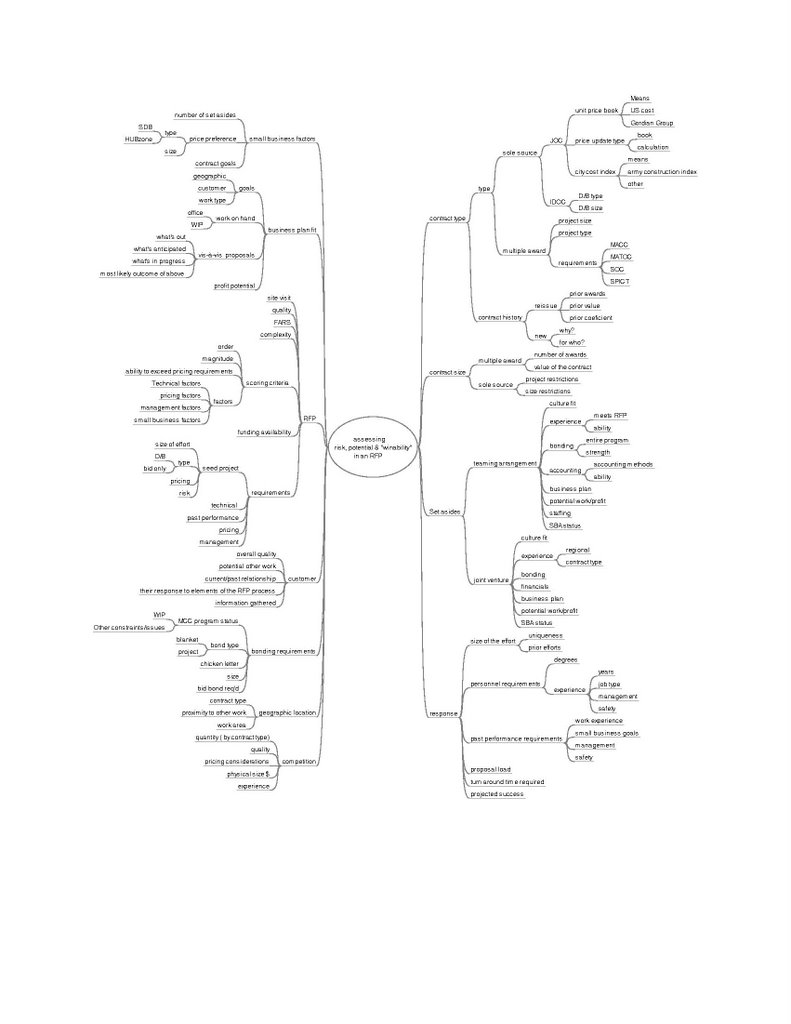 Above is a more complex example of what it can do I use to make decisions concerning Requests For Proposals. Here are some examples I pulled off the internet.
  Even in German you get the idea. Here is another done by hand. I should mention that doing them by hand is a viable method, but I find the drop and drag function in a program very useful. (Also, because I am such a bad speller I rely on spell check - to me, spell check is crack) I often start with a hand drawn copy to ferret out the main ideas and then take it to the computer for revision and expansion. There is wow factor when you actually sit down and make one of these. I would almost call it an epiphany. If you give it a try and you are consistent I guarantee a very satisfying result.
Monday, September 11, 2006
Recent & recommended

I can never seem to limit myself to a few specialties and my reading reflects my schizophrenic interests. Jack of all trades, master of none. So, perhaps a few "recent & recommended" books might spur someone to read some things I found very interesting.
Self Made Man: One Woman's Journey into Manhood and Back Again - Norah Vincent
From a man's perspective what she discovered is not surprising, but what woman don't understand about men is very surprising. I enjoyed her concise writing style and some of her observations are right on, but unusual and thought provoking. For those with an interest in gender issues.
ABC news
Norah's website
Amazon's reviews
Why Gender Matters:What Parents and Teachers Need to Know about the Emerging Science of Sex Differences- Leonard Sax MD, PHD
This is a must read for parents - even if you have only boys. I expect this is one book that might start a revolution
Amazon's reviews
(all of Amazon's pages have reviews, links, etc...)
...and while I'm on boys, here is another must read for parents of boys
The Wonder of Boys - Michael Gurian
Amazon's site with post by Michael Gurian and links to boysproject.net
Freakonomics: A Rogue Economist Explores the Hidden Side of Everything- Steven Levitt
This is one of those books that is pure pleasure. If you love counter thinking this is for you. Here's something Steven Levitt said:"I think of economics as a worldview, not a set of topics. This worldview has a few different pieces. First, incentives are paramount. If you understand someone's incentives, you can do a pretty good job of predicting their behavior. Second, the appropriate data, analyzed the right way are key to understanding a problem. Finally, political correctness is irrelevant. Whatever the answer happens to be, whether you think it will be popular or not, that is the answer you put forth".
The book's web site
Amazon
Guns, Germs, and Steel: The Fates of Human Societies - Jared M. Diamond
Here's another Gem of radical thinking. He won a Nobel Prize for it too! For those with a interest in anthropology.
Amazon
The Tipping Point - Malcolm Gladwell Blink - Malcom Gladwell
It is hard to pin these books down. Even after reading them twice I am not sure I can define a "subject" - business, advertising maybe. Just read them - a pleasure and something to get you thinking.
Amazon
The World Is Flat: A Brief History of the Twenty-first Century - Thomas L. Friedman
Here's one about gobalization. This one forces a world view we may not be ready to accept. Interestingly, after reading about India's workforce I received an answer to a help wanted on Monster.com from Bangalore. The world is truly flat.
Amazon
Mr. Friedman's web site
Healing the Soul in the Age of the Brain: Becoming Conscious in an Unconscious World - Elio Frattaroli
The world of psychiatry doesn't agree on much. This book exposes some of the rawness and really opened my eyes to the therapeutic process, drugs, and Freudian theory. Upon reading this and discussing it with my shrink I found he knew that man and agreed with his theories - small world. For those interested in psychology and therapy.
Amazon
The Gecko's Foot: Bio-inspiration: Engineering New Materials from Nature - Peter Forbes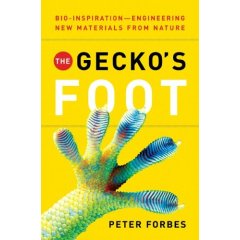
Really great stuff about bio-engineering, materials engineering, and the new science of bio-inspiration. For example, a spoon, based upon the lotas plant, upon which honey will not stick - rolls off and leaves the spoon clean!
Amazon
Friday, August 18, 2006
Ouch!
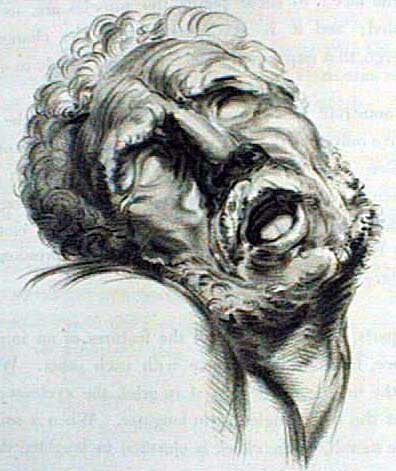
Pain is a rather interesting force. For obvious reasons I have been thinking about this topic again. I actually have a "philosophy" built around the entire subject developed recuperating from the dissolution of my first rather short marriage, now almost twenty-years ago. Of course, I am talking about emotional pain. Thinking about this I am just reminded of something my grandfather said as he lay dying just this last year. I was saying good-bye for the last time; "Artie", he said, (he is Artis, so in my family, I am Artie) "you’ve had a hard life". I don't remember what he said next - that stuck like a spear in my side. I laid my head on his chest and sobbing, said my good-byes leaving with that thought in my head. I flew back to Colorado and I think he died the next night. So, I will never be sure why he said that, especially since he watched his young wife die, leaving him with four little children. He did not have an easy life. He was born into a family of sharecroppers in the Deep South during the depression, and that was just the start. Gradddaddy's perspective deepens the mystery. Anyway, I guess I have a reputation; although, I really don’t see my life that way. There are plenty of people with hard lives. I don’t have a corner that commodity. But, one must always remember that pain is relative. Some people experience great trauma while growing up and some very little. It can very well be true that the person who really suffered some serious abuse can be quite fine, while the later develops some serious psychiatric condition. The capacity of the psyche to either overcome or succumb can never be minimized, nor can psychiatry portend some condition based upon any set of tragic events.
Back to the subject though -– physically, pain is a necessary evil; it literally keeps us alive. Touch the hot stove and it is a sure thing that pain will "make" you save your hand. Without the pain, you could very well just burn your finger right off. Not an altogether pleasant thought making it quite easy to see that pain is a good thing. But, (here's a great dichotomy) only through pain can we achieve greater fitness and the benefits that implies. The saying, "no pain, no gain" is familiar to us all. What we are accomplishing with the pain is building a better "machine". So, the more "pain" you can embrace while working toward a fitness goal, the more fit you will be.
Physical pain, therefore, has two aspects - one positive (building the body) and one negative (saving the body from a threat). There are those that avoid physical pain like the plague. Workout -– never, be hungry -– unthinkable; I could go on, but you see the point. Those life choices produce negative results, which in turn produce things like obesity, which in turn can produce all kinds of physical problems. All of this is fairly obvious, but apply the physical aspects of pain and pain avoidance to the other parts of our lives (emotional, spiritual, and relational) and wallah; you've got something to think about.
Think what happens when you avoid emotional pain. Think about the long-term affects - think about the relational affects. I am quite sure you can relate. This is huge if you think about it. Now, think about “"exercising" emotions – working out. A completely different picture begins to form. What if we were as proactive with our emotional muscles as with our quads? I wonder what we can do with our wives/husbands for a little work-out. I know I have had some serious workouts lately. Are you avoiding one - maybe, maybe not. It isn't pleasant, but I promise you some strong quads.
Sunday, July 16, 2006
curiosity killed the cat
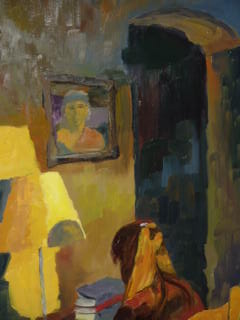 What is the difference between those who, for lack of a better saying: are simply insanely curious, and never stop learning; and those who never really care about much besides what is right in front of them? It is precisely that curiosity that drives the machine of humanity forward and, I think more importantly, each one of us forward personally. I think every one of my friends have this quality - I think that's telling and I certainly enjoy people who are insatiably curious. Tammi certainly has this quality. I don't think we would enjoy so much together without it. (By the way, this is a part of one of a very curious person's painting - Tammi's. It is Erin studying - the person on the wall doesn't exist in our house or on our wall. It is someone from the past looking out to the future. I thought it an appropriate picture!) Anyway, kids have an almost universal curiosity. When does it leave and why do some people retain it and some not? How do we pass it to our kids or at least keep it alive? It seems to me to be one of the foundations of success. Here are some good quotes about being curious.
- I think, at a child's birth, if a mother could ask a fairy godmother to endow it with the most useful gift, that gift would be curiosity.
Eleanor Roosevelt
- Curiosity is one of the most permanent and certain characteristics of a vigorous intellect.
Samuel Johnson
- I am neither especially clever nor especially gifted. I am only very, very curious.
Albert Einstein
- Judge a man by his questions rather than by his answers.
Voltaire
- Curiosity is the very basis of education and if you tell me that curiosity killed the cat, I say only the cat died nobly.
Arnold Edinborough
- The cure for boredom is curiosity. There is no cure for curiosity
Friday, July 14, 2006
just when thought you knew.... evil axioms
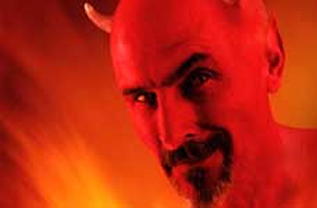 I have continually been fascinated by dichotomy - it's everywhere, yet most people, given a choice, will tell you that most things are primarily black and white. Suppose I asked you if the statement, "look before you leap" is a reasonable and applicable axiom and if you might generally apply it to you life. I think concurrence would be wide-spread. Now, suppose I asked the same question about the statement, "he who hesitates is lost". What now? What if I reverse the questions? These "truisms" are not as true as we suppose. In fact, I could argue that each is mutually exclusive of the other and therefore, neither is true. Yes, I can hear you say that it depends on the circumstance. That is precisely the point. What good is any axiom if it isn'’t a guide? In my book, they become subject to the whim of the user, perhaps USED to justify an action, or a result. So axioms are, in the end, worthless. The fact that I see "both sides of the paper" at one time drives my wife crazy. It makes it hard to get a firm answer and in fact, I know it to be true. Sometimes I think that I've done it, yes - whoever I'm speaking to understands - they see both sides. Mostly, I think it is fleeting glances and then it is gone. For me it is like understanding the theory of relativity. When I watch a special or read a book, I think, yes I've got it; I understand. Yet, in five minutes it is all gone again and I feel like a thick-headed moron standing around with his britches full. It is a nightmare to communicate, but it is a great way to approach any decision. For work, the partners in the company recently took management tests and I scored strongly in the big picture/little picture - both sides of the coin thinking. I just can't help it. It doesn't cripple me when decision making; it is terrific, but it is damn hard to communicate all the back and forth to more concrete thinkers. Because of this personal little wrinkle, I am interested in and I have collected axioms similar to the one given above for several years now. Some I ran across, some I brought together, and some are pretty obvious. This compendium will screw you up forever -– here it is!
- Look before you leap; but, he who hesitates is lost.
- Never judge a book by its cover; but clothes make the man.
- The early bird gets the worm, but the second mouse gets the cheese.
- Absence makes the heart grow fonder; but familiarity breeds contempt, and out of sight, out of mind.
- If at first you don't succeed, try, try again; when the going gets tough, the tough get going; and where there's a will, there's a way, but don't beat your head against a wall.
- Two heads are better than one, but paddle your own canoe.
- It's better to be safe than sorry, but nothing ventured, nothing gained.
- Many hands make light work; but too many cooks spoil the broth.
- The bigger, the better, but the best things come in small packages.
- What will be, will be, but life is what you make it.
- With age comes wisdom, but out of the mouths of babes come all wise sayings.
- The more, the merrier, but two's company, three's a crowd.
- Opportunity knocks but once; but when one door shuts, another opens.
- A word to the wise is sufficient; but talk is cheap.
- A man's reach should exceed his grasp; but don't bite off more than you can chew.
- You are never too old to learn; but you can't teach an old dog new tricks.
- Birds of a feather flock together; but opposites attract.
- When in Rome, do as the Romans do, and if you can't beat them, join them; but to thine own self be true. Don't look a gift horse in the mouth, but beware of Greeks bearing gifts.
- A penny saved is a penny earned; but penny-wise, pound-foolish, and if you buy cheaply, you pay dearly.
- Haste makes waste, but time waits for no man.
- Fools rush in where angels fear to tread; but seize the day, and strike while the iron is hot.
- If something is worth doing, it is worth doing well; but half a loaf is better than none.
- Never put off until tomorrow what you can do today, an ounce of prevention is worth a pound of cure, and there's no time like the present; but don't cross the bridge until you come to it.
- Actions speak louder than words, but the pen is mightier than the sword.
- Better the devil you know than the devil you don't know; but variety is the spice of life.
- The best things in life are free, but no pain, no gain.
- Nothing ventured, nothing gained; but, it's better to be safe than sorry.
- A word to the wise is sufficient, but talk is cheap.


