

I got up early Saturday morning and saw Orion and felt a deep melancholy darken the night. It was barely visible just coming up over the eastern horizon. The vision of him in the night sky may not mean much to some, but to me the great hunter signals fall and marks yet another year and the change of seasons.
Orion is a winter constellation, missing from the summer sky, but clearly visible when the frost lies deep. As the days become shorter and the cold becomes profound, the earlier it will rise. One of the best known and most recognizable star-patterns in the sky, Orion represents an heroic hunter of Greek myth.
Look for it if you're up early in late sumer. His belt is made of three very large white stars with two famous nebula, the Flame and Horsehead Nebula, located in the belt. In his sword one of the stars is actually the Orion Nebula - a cloud of gas and/or dust in interstellar space, but it is quite visible.
Orion also contains some of the best known stars in the sky, with perhaps the most famous being the variable red giant Betelgeuse, which marks Orion's left shoulder. Betelgeuse shines an amazing 60,000 times brighter than our sun and is about 600 times larger than our sun. You can see its redness with the naked eye. At his right shoulder is another variable star, this time blue in color, known as Bellatrix. At Orion's right foot is yet another famous star, blue like Bellatrix: the supergiant Rigel. These are the bluest and reddest stars in the sky.
Try to spot it - it is quite easy, and after several years you will look to the eastern sky and know time hurries on.
Sunday, August 26, 2007
Fall

Thursday, July 12, 2007
Kind of neat!

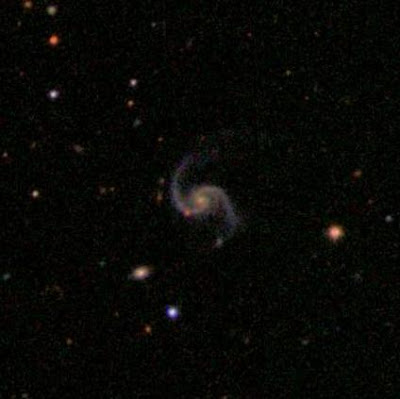
One of my interests is astronomy and perhaps this might get you interested. Some cosmologists need help to classify galaxies and you can sign up and help on the web. There are something like a couple of million to classify and I guess they got a bit tired of it. Many hands make light work. Basically, you will be the first person seeing about 100% of what you see and categorize.
Apparently, the human brain is much better at recognizing patterns than a computer. Here is a shot of several of the ones that came up on my screen. You are seeing them for the first time (well...second time). The first is a spiral clockwise galaxy.  I have no clue where. See my post on the milky way for some perspective on just how big things really are. Imagine several million Milky Ways...no, not the candy bar - our galaxy.
Here's the site.

Sunday, September 10, 2006
Milky Way

Recently, I was thinking about the Milky Way and remembering some of the places and times I've been mesmerized under its white embrace. There are many, and to me I always have clear memories of when it dazzled me. It never fails to inspire. I suppose that once upon a time most anyone could go out onto the front porch, or perhaps the tepee, maybe the hogan, or the yurt and simply expect it to be there. That, of course, is no longer. It is now special; reserved for memories and places we may wish we were at right now. There are many people who most likely have never seen it - not truly.
The Milky Way is the name we all know best, but it is only part of the name. It is the Milky Way Galaxy - it is where we live. Most readers have seen pictures of galaxies; a round, spiral, flattened disk. These galaxies are spread around the universe and we see most of them a single stars; although, in fact, there are billions and billions of stars in what we perceive as one star. Our galaxy is roughly 150,000 light-years in diameter and contains Earth's solar system. (A light year is 5,878,625,373,184 miles - yes, that's almost 6 trillion miles in one year. By the way, the farthest galaxy is 13 billion light-years away. Do that math!) We are on the outer edge, thus what we know as the Milky Way is really looking inward toward the center of our galaxy and what we see is a white irregular luminous band that encircles the sky defining the plane of the galactic disk. Kind of similar to being a mite on a pancake. Looking up you might be able to see "out of the pancake"; however, looking toward the middle the mite would only see pancake and not the outside world beyond the pancake. The Milky Way system contains hundreds of billions of stars and large amounts of interstellar gas and dust. The Sun lies in one of the Galaxy's spiral arms, about 27,000 light-years from the center.
But, back to the point - it's not science, it's memories. Moab is one of my favorite places. You can disappear in many places and be at least a hundred miles away from the nearest light and the cites are so far and so small and so spread out they don't affect the sky. I always believe I am looking at the same sky as the Fremont and the Anasazi. The Winds offer the same solitude, but higher. Sleeping at 12,000 feet one can hardly separate the stars one from the other. You can even see satellites wiz across the sky. Mt. Robson in the Canadian Rockies is also unforgettable.
There is also a special place in Vermont. The stars aren't quite so bright there, but the place in full of memories, and fun, and the stars are just the icing. Once Tammi and I, when we first met, slept under the stars in western Maryland. The Milky Way shone like new love. I will never forget the view and the feeling.
The milky way makes me think of my friends. Of being high, and cold, and tired. Of fun, of good sleep, and of fires, and climbing, and blankets, and easy talk. It is the stuff of life.


